



.png)

.png)
Co-hosting is the lowest-risk way into the short-let business. You manage someone else's property, take a share of the revenue, and never sign a lease or tie up capital. Airbnb's Co-Host Network, live in the UK since late 2024, has made finding owners easier than it has ever been. This guide covers how to become an Airbnb co-host in the UK: what the role actually involves, how to qualify for the network, what to charge, and the point where co-hosting quietly turns into running a property management business.
Table of Contents

⭐ Rated 4.8/5 by 2,500+ Hosts
.webp)
⭐ Rated 4.8/5 by 2,500+ Hosts
🚀 Start & Scale Your Airbnb Business with Houst
Join Houst’s Airbnb Business Partnership Program to start, manage, and grow your short-term rental business. With expert marketing, automation tools, and dynamic pricing strategies, we help you maximise earnings and scale faster.
⭐ Rated 4.8/5 by 2,500+ Hosts
What an Airbnb co-host actually does
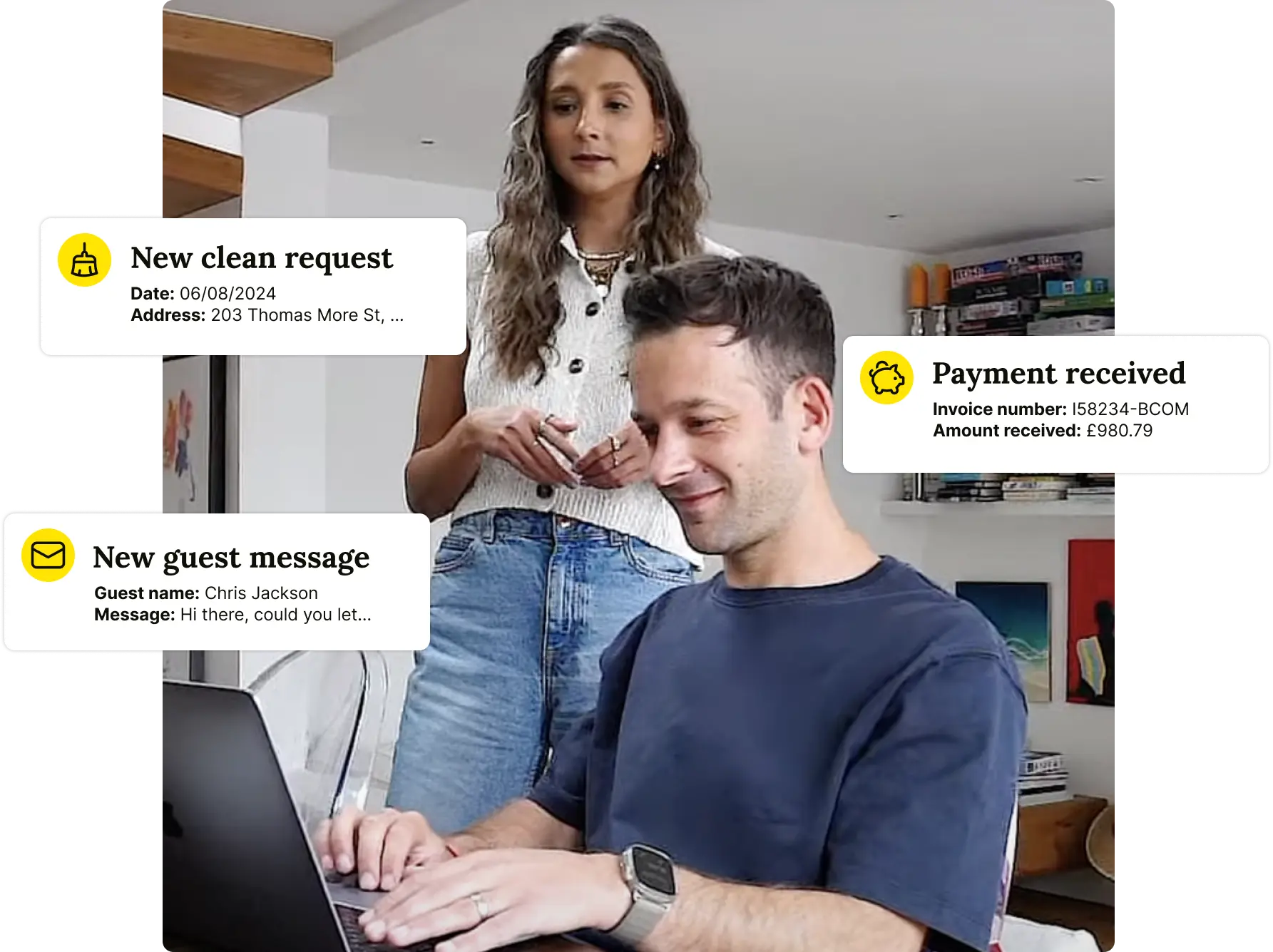
A co-host manages the day to day of a short-let on behalf of the owner in exchange for a share of the booking revenue. You handle pricing, guest messages, cleaning schedules, the listing itself and the guest experience. The owner keeps the property and the ownership risk. You keep a percentage of what it earns. You do not hold a lease and you do not take on the property's costs, which is exactly what makes it a low-risk entry point.
Airbnb gives owners three permission levels to grant a co-host: full access, calendar and messaging only, or calendar only. In practice the level matters less than the two things you agree privately with the owner: the exact scope of what you handle, and how you get paid. Everything else follows from those.
Co-host vs property manager
The words get used interchangeably but the structure differs. A co-host is usually a contractor paid a commission on one or a handful of properties. A property manager runs it as a business, often across many properties, with the systems, staff and compliance that scale demands. Co-hosting is the entry point. Property management is what it becomes if you keep growing, and the crossover happens sooner than most people expect.
How to qualify for Airbnb's Co-Host Network
Airbnb launched its Co-Host Network in late 2024, a marketplace that puts experienced co-hosts in front of owners actively looking for help. It is not the only way to find clients, but it is the most direct, and the UK was one of the founding markets. To appear in its search results you need a track record, not just an account.
The eligibility thresholds
To join and stay visible in the network you need at least 10 completed stays, an overall rating of 4.8 or higher, a cancellation rate under 3%, and a response rate of 90% or better within 24 hours. Let your rating slip below the threshold and you can drop out of search results. The practical implication is that you build the track record first, usually by managing a property for someone you already know, then apply once the numbers are there.
One detail that trips people up
Your listing on the network has to be under your personal name, not a company name, unless you are a registered business in one of the specific countries where that is allowed. Sort out how you present yourself before you apply rather than after.
What to charge as an Airbnb co-host
UK co-host commission is a percentage of gross booking revenue, and the rate tracks the scope of work. Basic co-hosting covering messaging and calendar management runs around 10 to 15%. Full-service co-hosting, where you handle everything from guest communication to cleaning coordination and maintenance, runs higher, commonly 20% and above. Some co-hosts charge a flat monthly fee per property instead of a percentage, which works well if you run your own cleaning crew and want predictable income.
Model the numbers before you agree a rate
The maths is simple but worth doing per property. On a property generating 3,000 pounds a month in bookings at a 15% commission, you earn 450 pounds a month, or 5,400 pounds a year, from that one property. One property is not a living. The model works when it scales: manage eight to twelve properties and it becomes genuine full-time income, which is the point where you stop being a contractor and start running a business.
One thing to get right in the agreement: Airbnb's own host service fee comes out of gross revenue, and cleaning fees are usually passed to the cleaner rather than to you unless you provide cleaning yourself. Be clear about what counts as revenue before you sign.
Get the agreement in writing
The most expensive mistake in co-hosting is a handshake deal. Without a written scope, a response-time standard and a termination clause, every disagreement becomes one person's word against another's, and it always surfaces at the worst moment, mid-stay with a guest already on site. A single page both parties acknowledge prevents most disputes.
Your agreement should nail down the scope of services, the exact commission percentage, who collects and keeps the cleaning fee, when payouts are released and whether they run through Airbnb's payout split or a separate transfer, and how either side ends the arrangement. Confirm both sides are reading the same numbers the same way before the first booking, not after the first problem.
When co-hosting becomes a property management business
Managing one property for a friend needs no licence and no company. You are a contractor earning a commission. That changes as you scale. Once you are running several properties you are operating a business, with the tax, systems and often licensing obligations that come with it. In the UK, taking on HMO or licensed properties, or managing at volume, can bring you into regulated territory, so check the position for the properties and areas you take on rather than assuming.
This is the point where a lot of co-hosts stall. Finding owners, pricing dynamically, coordinating cleaners, staying compliant and covering guest communication around the clock stops being a side income and becomes a full operation. If you want to build a short-let management business without assembling all of that infrastructure yourself, Houst's operating partnership gives you the brand, systems and support to scale faster than going it alone. Model the economics with the partnership calculator before you decide which route fits.
Airbnb co-host: common questions
How do you become an Airbnb co-host?
Start by managing a property for someone in your network to build a track record of strong reviews. Once you have at least 10 completed stays, a 4.8 or higher rating and a cancellation rate under 3%, you qualify for Airbnb's Co-Host Network, where owners can find and hire you. You can also find clients directly without the network.
How much do Airbnb co-hosts earn in the UK?
Co-hosts charge a percentage of gross booking revenue, typically 10 to 15% for basic messaging and calendar management and 20% or more for full service. On a property earning 3,000 pounds a month at 15%, that is 450 pounds a month per property. Income scales with the number of properties managed, and most full-time co-hosts run eight to twelve.
Do you need a licence to be an Airbnb co-host in the UK?
Managing a single property for an owner does not require a licence. As you scale to several properties you are running a business and may take on tax, registration and licensing obligations, particularly with HMO or licensed properties. Check the rules for the specific properties and local authorities you work in.
Is being an Airbnb co-host worth it?
It depends on scale. Managing a single property earns a modest side income, roughly 450 pounds a month on a property taking 3,000 pounds at a 15% commission. Co-hosting becomes genuinely worth it when you manage several properties at once, since your income scales with the number of listings while your systems and time investment do not scale as steeply. Most co-hosts who treat it as a business rather than a favour run eight or more properties.
What should an Airbnb co-hosting agreement include?
Put the scope of services, the commission percentage, who keeps the cleaning fee, the payout timing and method, a response-time standard and a termination clause in writing. A single page both sides acknowledge prevents most co-host disputes and removes the ambiguity that ends these arrangements badly.
Frequently asked questions
How do you become an Airbnb co-host?

How much do Airbnb co-hosts earn in the UK?
Do you need a licence to be an Airbnb co-host in the UK?
Is being an Airbnb co-host worth it?
What should an Airbnb co-hosting agreement include?


Reviewed by Andrei S., Head of Growth at Houst, for regulatory accuracy and commercial relevance.


